
The Revenue Pipeline Diagnostic™ identifies where operational friction, inefficiency, and revenue leakage may exist throughout the revenue ecosystem.
Revenue System Remediation™ implements the operational improvements designed to address those issues through workflow refinement, process alignment, operational accountability, automation implementation, reporting visibility, pipeline improvement, customer experience enhancement, and ecosystem stabilization.
The objective is not isolated tactical changes. The objective is creating a stronger, more coordinated revenue system.
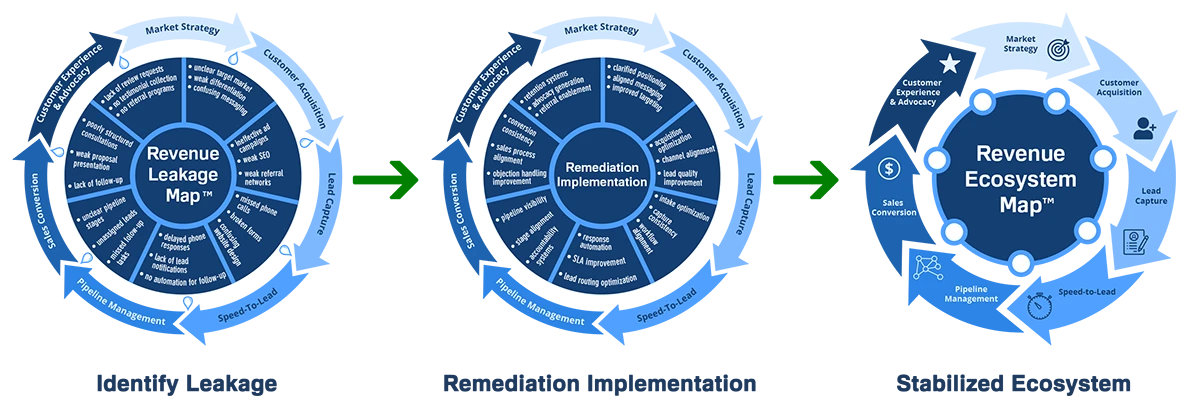
Revenue System Remediation™ follows a structured operational process: first identifying where friction and inefficiency exist, then implementing prioritized improvements, and finally stabilizing the ecosystem for long‑term performance.
Many organizations can recognize symptoms: inconsistent conversion, pipeline stagnation, operational friction, delayed response, weak visibility, customer experience gaps.
The challenge is implementing operational improvement consistently across interconnected systems while maintaining day‑to‑day execution.
Revenue System Remediation™ exists to help organizations move from diagnostic visibility to structured operational correction and alignment.
| Stage | Remediation Focus |
| Market Strategy | Clarify positioning, targeting, offer, messaging |
| Customer Acquisition | Improve channel alignment, lead quality, campaign coordination |
| Lead Capture | Improve intake workflows, forms, call handling, handoffs |
| Speed‑to‑Lead | Reduce response delays, improve routing, follow‑up consistency |
| Pipeline Management | Improve visibility, forecasting, accountability, stage alignment |
| Sales Conversion | Improve process consistency, objection handling, closing |
| Customer Experience & Advocacy | Improve onboarding, retention, reviews, referrals |
| Engagement Type | Typical Scope | Typical Timeline |
|---|---|---|
| Focused Operational Correction | Single operational area | 2‑4 weeks |
| Multi‑Stage Remediation | Multiple interconnected stages | 4‑8 weeks |
| Full Revenue System Remediation™ | Broad ecosystem implementation | 8‑12+ weeks |
Organizations know what needs improvement. The challenge is implementation while maintaining daily execution.
Common barriers: fragmented ownership, inconsistent accountability, bandwidth constraints, process complexity, tech fragmentation, limited visibility, competing priorities, weak coordination.
Revenue System Remediation™ bridges the gap from strategic awareness to structured operational execution.
After remediation, organizations often shift to optimization, forecasting, scenario modeling, scalability, and accountability oversight.
If operational friction, weak visibility, inconsistent execution, delayed response, pipeline inefficiency, or customer experience gaps are limiting growth, structured remediation may help.

Revenue Systems Consulting Group helps businesses improve the systems that drive revenue growth.